




 PL
PL EN
EN UK
UK DE
DE
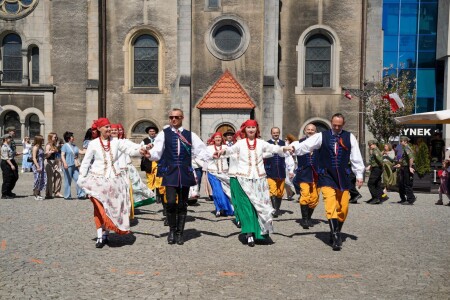
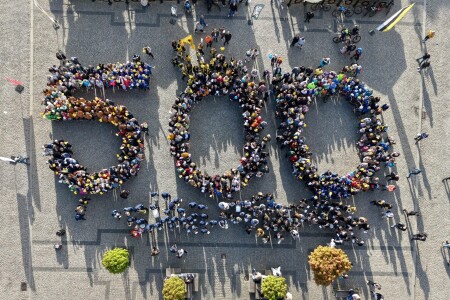
May Day in the style of Tarnowskie Góry 2026: it was festive and danceable
Wczoraj
30.04.2026 r.
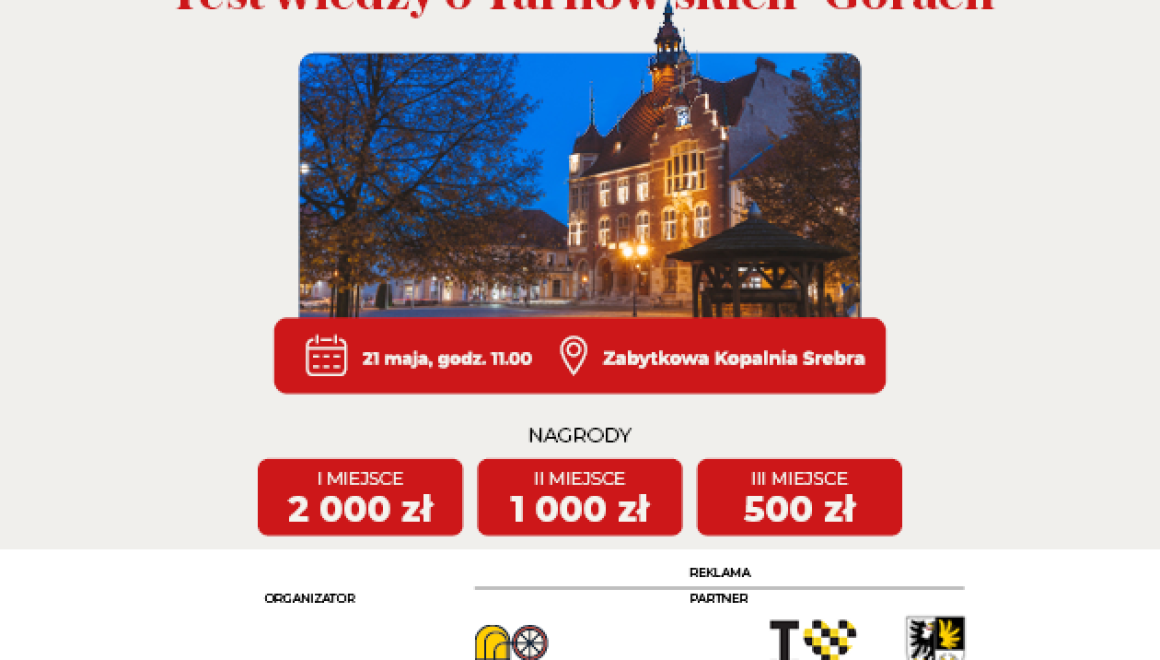
On the occasion of the 500th anniversary of the granting of city rights to Tarnowskie Góry, we would like to invite students of secondary schools in Tarnowskie Góry to participate in a unique educational event - the "Tarnowskie Góry Knowledge Test". It is a competition for students interested in the history of the town, its rich mining and cultural heritage and the most important events in its history. The test will be held on 21 May at the Historical Silver Mine at 11.00 a.m. and will be an opportunity to test the knowledge of 100 secondary school students. Participants will face 40 questions relating, among other things, to the history of the founding of the town, mining traditions, monuments, important places and the contemporary life of Tarnowskie Góry".
On 30 April 1526, Prince John II of Opole and the Margrave of Ansbach and the Duke of Carniola, Jerzy Hohenzollern, granted the privilege of mining freedom ("Bergfreiheit") within their respective domains. The privileges, written down in German, encouraged miners - mainly from the area around the Duchy of Ansbach and Olkusz - to settle in the area of today's Tarnowskie Góry.
This date is considered to be the historical beginning of Tarnowskie Góry. Numerous birthday events will be held in the city over the coming months. One of them will be the Tarnowskie Góry Knowledge Test.
Tarnowskie Góry calendar
We will start our knowledge ordering with dates and the most important events.
- 1201 r. - In a bull of Pope Innocent III the village of Repty - Reptones - was mentioned for the first time as a property of Wroclaw Premonstrantensian monastery.
- 1247 r. - Prince Władysław I of Opole issued a mining privilege - the so-called Free Lead - granting Reptes the right to mine lead ore in the area.
- 1289 r. - The Duke of Bytom, Gliwice and Kozle, Casimir II, paid a fief homage to the King of Bohemia, Wenceslas II, in Prague. Thus, the Bytom region - including the area of today's Tarnowskie Góry - became part of the Crown of the Kingdom of Bohemia.
- 1490 r. - According to legend, a peasant called Rybka, living in the settlement of Tarnowice (today's Tarnowice Stare - the name of Tarnowskie Góry comes from this settlement), discovered the first lump of ore in a field in the area of today's city. As a result of this event, the local mineral wealth began to attract numerous silver and lead miners, who became obsessed with a veritable silver rush. Soon a mining settlement was established here, and with it "mountains/mountains", or in Old Polish - just like in German "Berg" and Czech "hory" - mines. It was from these that the "mountains" in the name of the village originated.
- 1526 r. - On 30 April, Jan (a.k.a. Hanusz/Janusz) II, the Duke of Opole, called Dobra, and the Margrave of Ansbach and Duke of Carniola, Jerzy Hohenzollern, granted the privilege of mining freedom ("Bergfreiheit") within their domains. The privileges, written down in German, encouraged miners (mainly from the area of the Duchy of Ansbach and Olkusz) to settle in the area of the emerging town. The word gwarek itself comes from German ("der Gewerke") and means organiser of production or shareholder/owner of a mining company.
- 1528 r. - The Margrave of Ansbach and the Duke of Carniola, George Hohenzollern, and the Duke of Opole, John II, issued a mining law in Opole on 16 and 18 November 1528 called the "Gorny Ordnance". The document established, among other things, the mining and municipal authorities in Tarnowskie Góry.
- 1683 r. - On 20 August, King John III Sobieski stopped in Tarnowskie Góry on his way to the relief of Vienna.
- 1784 r. - On 16 July in the exploratory shaft "Rudolphine" in the area of Bobrowniki (then under the town, today within Tarnowskie Góry), in the presence and by order of Count Friedrich Wilhelm von Reden and Minister - Prime Minister of Prussia Friedrich Anton von Heynitz, deposits of silver and lead ore were discovered.
- 1788 r. - On 9 January, in the 'Fryderyk' mine, the first steam engine in the mining industry in Tarnowskie Góry and in the whole ore-producing region was put into operation, imported from the British Isles for the purpose of draining the mine workings (a 32-inch Newcomen-type steam engine was manufactured in 1787 at Penydarren ironworks in South Wales, owned by Samuel Homfray). The commissioning of this 'fire engine' is regarded as the symbolic start of the Upper Silesian industrial revolution.
- 1790 r. - Johann Wolfgang von Goethe, accompanying Prince Carl August, travelled to Tarnowskie Góry in September 1790 to see the region's first steam engine in operation.
- 1803 r. - The first Mining School in Upper Silesia was founded in Tarnowskie Góry.
- 1854 r. - Construction of the first, today the oldest operating narrow-gauge railway in the world was started from Tarnowskie Góry as an ore mining centre to Wirk (now a district of Ruda Śląska).
- 1884 r. - On 6 October near Rept Nowy (currently a part of Rept Śląski, a district of Tarnowskie Góry) the first inter-communal waterworks complex in Upper Silesia was put into operation, which pumped water from underground excavations of the "Fryderyk" mine and supplied it, among others, as far as the Royal Steelworks (currently Chorzów)
- 1903 r. - On the former mining area, south-west of the city centre, a Municipal Park, unique in Europe, was created. This was probably the first successful revitalisation of post-industrial land converted into recreational areas in Europe.
- 1953 r. - On 19 March, the Committee for Monuments and History of the Tarnogórski Area was established in Tarnowskie Góry. Less than a year later, on 31 January 1954, the first General Assembly was convened, at which the Board of the Association of Lovers of History and Monuments of the Tarnogórski Region was elected. Its first chairman was Alfons Kopia.
- 1955 r. - A group of enthusiasts from the Association of Lovers of History and Monuments of the Tarnogórze Area erected the famous Guernsey Bell Tower on the square by the parish church.
- 1957 r. - Between 14 and 18 September the first Gwarki took place.
- 1976 r. - On 5 September the Historic Silver Mine was opened to the public.
- 1994 r. - On 30 December the districts of Miasteczko Śląskie, Żyglin and Żyglinek as well as the villages of Bibiela and Brynica (all joined the city in 1975) were separated from Tarnowskie Góry as the municipality of Miasteczko Śląskie.
- 2001 r. - On 16 March the first aquapark in Upper Silesia was opened.
- 2011 r. - In a palace dating from the end of the 18th century, a self-governing cultural institution of the Commune of Tarnowskie Góry called "Palace in Rybna" was established.
- 2017 r. - The post-mining monuments of Tarnowskie Góry were inscribed on the UNESCO World Heritage List. The decision was made on 9 July in Krakow during the 41st session of the World Heritage Committee. It was the 15th Polish site on this prestigious list and the first in the Silesian Voivodeship.
- 2025 r. - On 11 December, the Station of Culture, which operates on the first floor of the railway station under the auspices of the Tarnowskie Góry Museum, was officially opened.
Tarnowskie Góry Knowledge Test
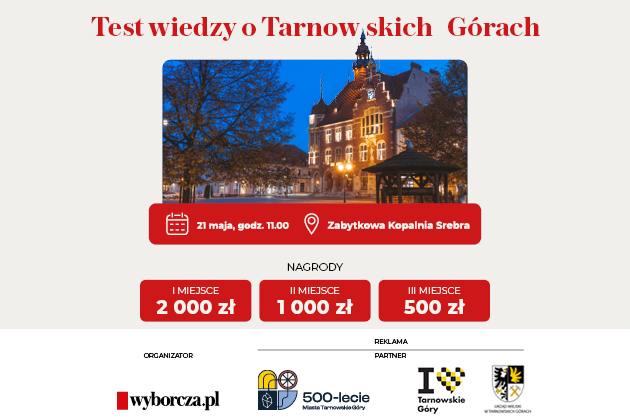
On the occasion of the celebration of the 500th anniversary of the granting of city rights to Tarnowskie Góry, we would like to invite students of secondary schools in Tarnowskie Góry to participate in a unique educational event - the "Test of Knowledge about Tarnowskie Góry".
The test will be held on 21 May in the Historic Silver Mine at 11 a.m. and will be an opportunity to test the knowledge of 100 secondary school students, develop regional interests and build local identity. Participants will face 40 questions concerning, among other things, the history of the city, mining traditions, monuments, important places and contemporary life of Tarnowskie Góry." Prizes await: - 1st place - PLN 2000, - 2nd place - PLN 1000, - 3rd place - PLN 500.
Link to report participation in the test: wyborcza.pl/tarnowskiegory
Wczoraj
Wczoraj
Wczoraj

01 May
30 April
29 April

29 April

25 April

24 April
24 April

23 April
23 April