




 PL
PL EN
EN UK
UK DE
DE
News
A ceremonial session of the Town Council to mark the town’s 500th anniversary
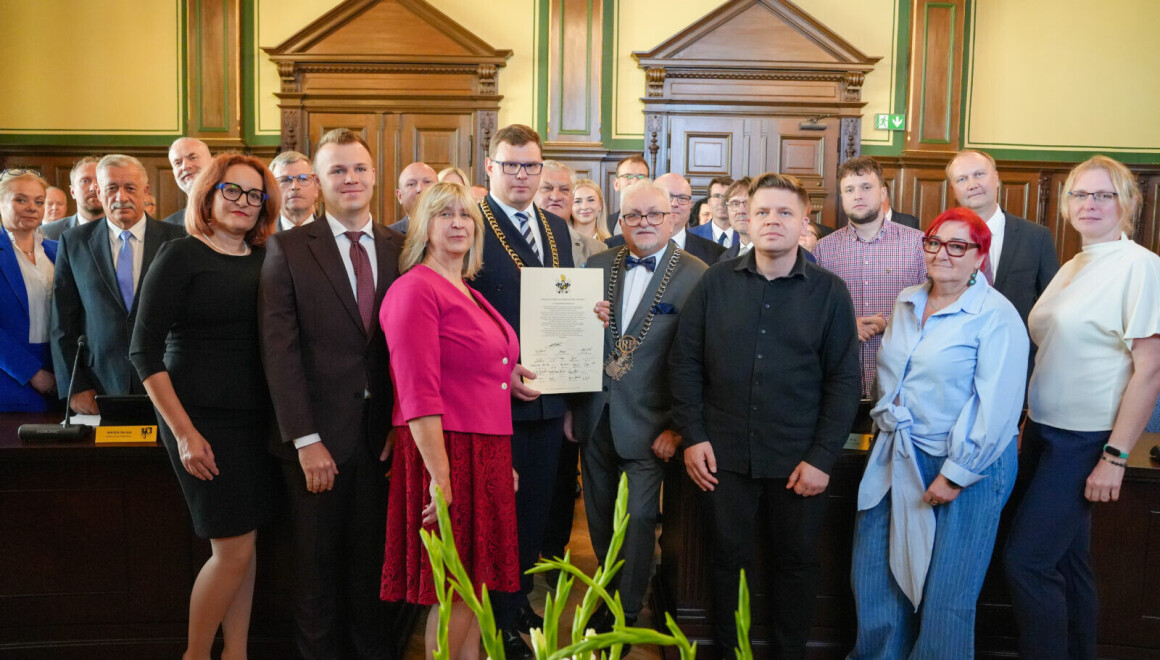
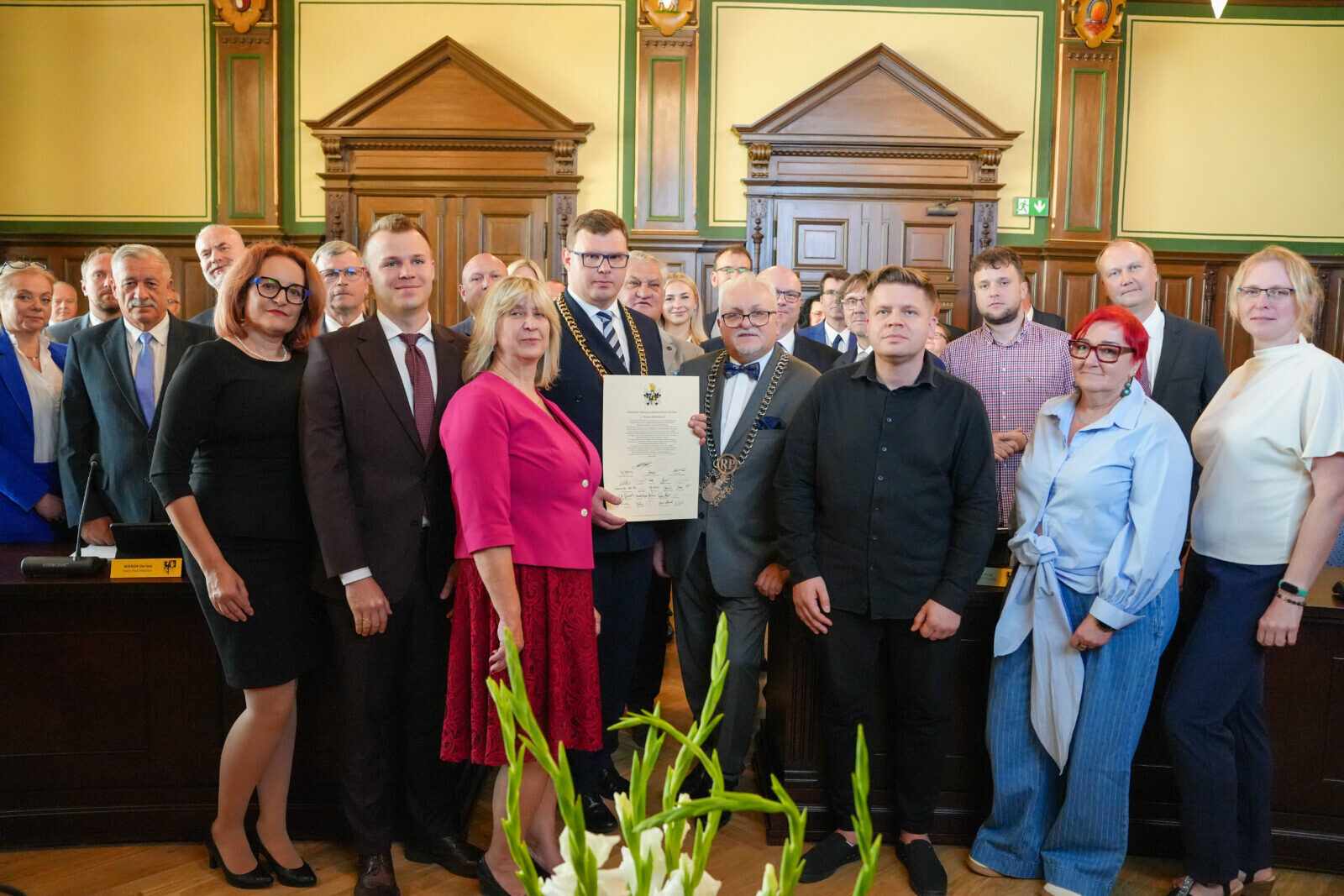
A ceremonial sitting to mark the 500th anniversary of Tarnowskie Góry: a new chamber, a new monograph and a declaration by councillors.
“The history of Tarnowskie Góry is fascinating and represents a unique phenomenon,” said Professor Ryszard Kaczmarek, speaking about the town’s 500th anniversary at the opening of today’s ceremonial session of the Town Council. The councillors met in the refurbished Council Chamber, which has been restored to its original design to mark the anniversary. (more about the chamber here)
Professor Kaczmarek, who, together with Prof. Jerzy Sperka, led the work on the monograph of Tarnowskie Góry, mentioned that two myths lie at the root of our town’s history: that of the peasant Rybka and the region’s first steam engine.
– “Despite development – including spatial development – the centre of Tarnowskie Góry has retained its function, and the town has thus preserved its character,” the historian pointed out, noting that recent history – that is, the 20th and 21st centuries – has yet to produce such a myth; yet the nature of history is that it unfolds before our very eyes, though we are usually unaware of it.
Professor Sperka pointed out that the early history of the town, shaped by the arrival of people from all over the world, was a sort of ‘Wild West’ and a spontaneous process of creation through action.
– ‘If our town had been founded under German law, it would have had a market square and streets laid out from the outset – in Tarnowskie Góry, everything unfolded just as in the legend of the peasant Rybka’s discovery of silver, somewhat by chance’ – he explained, adding that the existence of the peasant Rybka, recorded in the land register – as it turns out, as Rypka – had finally been confirmed.
We will soon be able to read about him and the town’s subsequent history in a three-volume monograph on Tarnowskie Góry, totalling over two thousand pages.
– “This monograph is largely the work of the people of Tarnowskie Góry themselves, because half of it – alongside historians – was written by them describing the town’s history,” explained Professor Sperka.
Councillors and local government officials, led by City Council Chairman Tomasz Olszewski, spoke today about the town’s residents of various nationalities, faiths and languages.
– “Today’s session is an expression of gratitude to all those who built this town,” he stated. “One thing that has remained unchanged here is our attachment to this land and the conviction that this is our home. Whether they were born here or chose to become residents of Tarnowskie Góry, it is they who have ensured that this borderland need not be a backwater,” said Olszewski.
“As a Silesian goes through life, he leaves behind a cultivated world.” The Mayor of Tarnowskie Góry, Arkadiusz Czech, quoted these words by the writer Alojzy Lyska, pointing out that for five centuries our land has echoed with Polish, German, Czech and Silesian speech, heard Catholic, Protestant and Jewish prayers, and flourished thanks to the work of people from various professions: miners, merchants, townspeople, railway workers, teachers, local government officials, entrepreneurs, artists and craftsmen. ‘It was they who, together, shaped our world!’ he said, recalling those who came before us. ‘We tell their stories, the story of how our town was built. We tell the true story.’ We owe this to our ancestors, the city’s current residents and our successors. For when we are gone, who will tell the truth about our world, which has been shaped over five centuries?’ he asked.
To honour previous generations and mark the 500th anniversary of Tarnowskie Góry, the councillors adopted a resolution containing a declaration paying tribute to the previous generations of Tarnowskie Góry’s residents.
– Aware of the value of our centuries-old heritage and our responsibility to preserve it and pass it on to future generations, we pay tribute to all those who, over five centuries, through their work, talent, entrepreneurship and service to the community have contributed to the development and prosperity of Tarnowskie Góry over the past five centuries – wrote the councillors. – We undertake, with due respect, to safeguard the heritage and achievements of previous generations and to develop a community based on freedom, responsibility, self-governance, solidarity and mutual respect.
The councillors supplemented the resolution with a declaration in which they undertook to exercise the mandate entrusted to them honestly, with dignity, impartially and fairly.
– “We declare that we will serve all the residents of Tarnowskie Góry, listen to their voices, safeguard the common good and make decisions with prudence, responsibility and concern for the town’s future – they promised, emphasising their commitment to “spare no effort to protect and preserve our cultural heritage, which is unique on a global scale, particularly the sites on the UNESCO World Heritage List”.
The declaration is to be solemnly read out during the first sessions of the City Councils’ subsequent terms of office.
Solemn Declaration by the Councillors of the Tarnowskie Góry Town Council
We, the Councillors of the Tarnowskie Góry Town Council, as we cross the threshold of Tarnowskie Góry Town Hall, declare that we shall leave our personal prejudices, grievances, interests and ambitions behind its doors.
Mindful of our town’s five hundred years of history and our responsibility towards past, present and future generations, we undertake to exercise the mandate entrusted to us honestly, with dignity, impartially and fairly.
We declare that we will serve all the residents of Tarnowskie Góry, listen to their voices, safeguard the common good and make decisions with prudence, responsibility and concern for the town’s future.
We pledge to spare no effort in protecting and preserving our cultural heritage, which is unique on a global scale, particularly the sites on the UNESCO World Heritage List associated with the underground water management system
May we be guided by the traditions of the free miners’ town, respect for the work and achievements of previous generations, and the duty to protect the heritage we have received and which we shall pass on to our successors.
For the good of Tarnowskie Góry, its residents and our entire community – we hereby declare.
Explanatory memorandum to the resolution:
500 years ago, on 30 April 1526, Jan II Dobry, Duke of Opole and Racibórz of the Piast dynasty, and Margrave George Hohenzollern-Ansbach, son of Frederick the Elder of Hohenzollern and Sophia Jagiellon, the nephew of Sigismund I the Old, also known as George the Pious, issued a mining charter. This privilege created the conditions for the dynamic development of mining and settlement in what is now Tarnowskie Góry, becoming one of the foundations of the emerging town. Two years later, in 1528, the ‘Ordunek Gorny’ – a mining statute – was issued, which regulated the principles of extraction, the organisation of mining, and
the functioning of the mining and municipal authorities. A period of exceptionally rapid development in the extraction of silver-bearing lead ores began, and with it, the development of the town itself.
From its very beginnings, Tarnowskie Góry was a multicultural town. People from all over Europe flocked to the burgeoning town. They brought with them their knowledge, experience, language, culture and faith. Catholics, Protestants and Jews lived side by side here; miners, farmers, craftsmen, merchants, townspeople, labourers, intellectuals and artists. People spoke Polish, German and Czech here, and for centuries also the Silesian dialect – the language of everyday life, of home and of this land. Even the ‘Ordunek Gorny’ required the mayor and councillors to be able to communicate in Polish, Czech and German – eloquent proof of just how diverse
the community that formed the town in its early days was.
The miners built a community that transcended languages and borders. People were drawn to Tarnowskie Góry by the silver-bearing galena. They were united by their work, their enterprise and their hope for success. It was precisely from this diversity
that the town’s unique culture emerged.
Early mining in Tarnowskie Góry relied on numerous small mines run by miners, among whom were merchants and members of the local nobility. As much as 80 per cent of the lead mined here was exported, supplying an extensive European network of mining and smelting centres. Tarnowskie Góry thus became part of the great European economic circuit as early as the 16th century.
Another turning point came at the end of the 18th century. On 19 January 1788, a Newcomen-type steam engine, imported from Great Britain, was commissioned at the Fryderyk Mine to drain the workings. Its introduction came to symbolise the beginning of the Industrial Revolution in Upper Silesia. A few years later, more modern Watt-Boulton engines also appeared in Tarnowskie Góry. In this way, the town once again found itself at the forefront of European technical progress.
Tarnowskie Góry was one of the most important centres for the extraction of silver and lead ores in Central Europe. In the centuries that followed, it remained the heart of the mining region – with the Fryderyk Mine and Smelter, the Mining Authority, the mining school founded by
in 1803, and the Upper Silesian Miners’ Guild, which provided security for miners and their families. When the importance of ore mining began to wane, Tarnowskie Góry found a new role for itself. At the turn of the 19th and 20th centuries, and particularly during the Second Polish Republic, it became a town of railway workers and one of the key points on the Silesia–Ports Coal Main Line (one of the largest economic investments of the reborn state), which linked Upper Silesia with Gdynia
and made Polish coal exports independent of the existing seaports and transport routes.
Numerous monuments to engineering and mining, preserved to this day, stand as a lasting testament to the city’s industrial history. In July 2017, the UNESCO World Heritage Committee inscribed the site known as ‘The Lead, Silver and Zinc Mine and its Underground Water Management System in Tarnowskie Góry’ on the World Heritage List. It was the 15th site in Poland and the only one in Upper Silesia to receive this prestigious distinction.
During the 20th century, Tarnowskie Góry also underwent significant spatial and demographic changes. The town gradually expanded its boundaries to include localities which, for centuries, had developed alongside the historic
urban centre. Following the Second World War, its boundaries came to include, amongst others, Lasowice, Sowice and Stare Tarnowice, whilst the basic layout of the present-day town took shape in the 1970s, when, amongst others, Bobrowniki
Śląskie, Repty Śląskie, Strzybnica along with Rybna and Opatowice, and subsequently Pniowiec, were incorporated. For a time, Miasteczko Śląskie, together with the surrounding villages, was also part of Tarnowskie Góry, but it once again became
an independent municipality in 1995.
This territorial expansion was accompanied by rapid population growth. Whilst in 1946 Tarnowskie Góry had a population of around 18,500, by the mid-1970s this had risen to over 60,000, and by 1980 to nearly 67,000.
The development of new housing estates, industry, the railway and public infrastructure meant that the former miners’ town was transformed into a large, multi-district urban centre, encompassing within its boundaries the localities of
, each with its own distinct history and local identity.
The adoption of this resolution forms part of the numerous initiatives undertaken by the town of Tarnowskie Góry, municipal institutions and community organisations in connection with the 500th anniversary of the town’s founding, which falls in 2026. The resolution will serve to preserve the memory of the town’s history, strengthen local identity and promote awareness of the rich, multicultural
and industrial heritage of Tarnowskie Góry. Once a town of numerous ‘hor’ (mines) near the village of Tarnowice.
It is the intention of the councillors of the 10th term of the Tarnowskie Góry Town Council that this declaration be solemnly read out during the first sessions of subsequent terms of the Town Council, marking the start of their work, thereby continuing the tradition and heritage of the Tarnowskie Góry local government.
Photos
Other news
-
-

Megahulajki are set to take Tarnowskie Góry by storm!
-
500 hearts to mark the 500th anniversary of Tarnowskie Góry
-

Free mammograms in the Market Square in October
-

12th Tarnowskie Góry Vintage Car Rally
-
The Mayor of Po Gwarkach: 500 words of thanks to mark the 500th anniversary
-
Watch the Gwarkowski Parade live!
-
Gwarki 2026: Results of the Sedlaczka Run
-
BOTG 2027: 13 projects successfully verified
-
The RR Brigade sends its regards and invites you to Gwarki
-

TESTING THE TUTTU EVOL CLIMBING SHOES
-
Transport to Gwarki 2026